
Memorials of Faith in Balog nad Ipľom
The sacred small monuments of Balog nad Ipľom include individual statues and sculptural groups that form part of the village’s Catholic religious and cultural heritage. The Three Saints sculpture group, the Pietà in the cemetery, and the statue of St. Elizabeth of Hungary are monuments from different periods, each preserving a distinct part of the community’s history.
These monuments make Christian faith and devotion to the saints visible beyond the walls of the church. Their locations and histories are closely connected with the past of Balog nad Ipľom, its religious traditions, and the collective memory of the local community.
The 1872 Sculpture Group of Three Saints
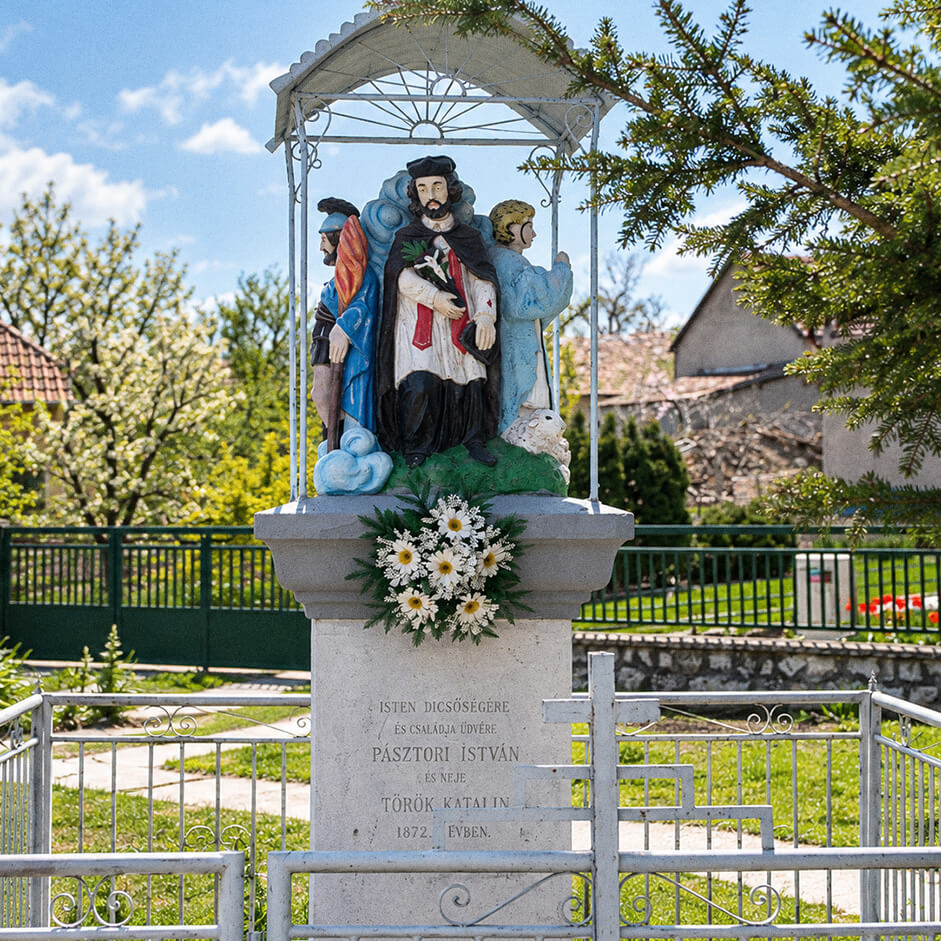
A sculpture group depicting St. John of Nepomuk, St. Florian and St. Wendelin stands at a crossroads in the centre of Balog nad Ipľom. Painted in a traditional folk style, the composition is one of the village’s notable sacred small monuments.
According to the Sacred Small Monuments Archive, the group was created in 1872. The three saints are represented together in a single composition carved from one block of stone. The inscription on the pedestal states that István Pásztori and his wife, Katalin Török, commissioned the monument for the glory of God.
Three Saints in a Single Composition
What makes the sculpture group distinctive is the depiction of three different saints within a single sacred composition. St. John of Nepomuk is known as the martyr of the sacramental seal, St. Florian is the patron saint of firefighters, while St. Wendelin has traditionally been venerated especially by livestock keepers and shepherds.
The sculpture group therefore brings together several important aspects of traditional rural Catholic devotion in a single monument. The saints are represented in the communal space of the village, at a meeting point of roads.
History of the Sculpture Group
Date of Erection
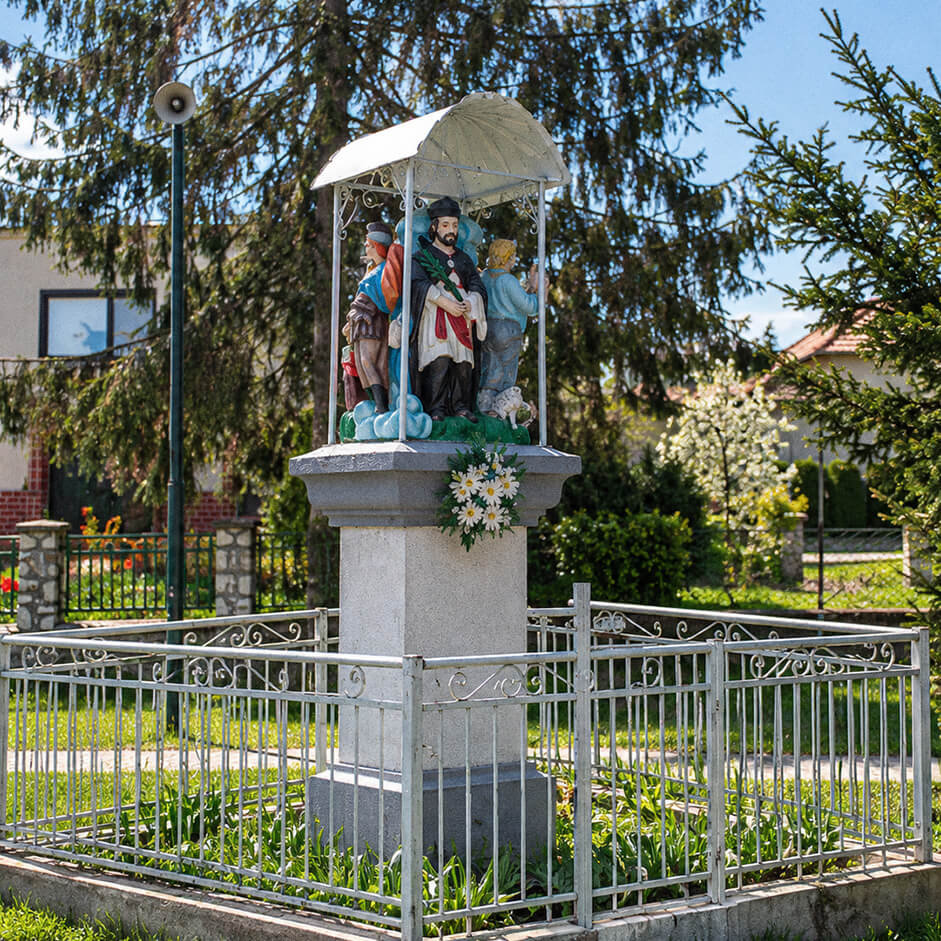
The sculpture group was created in 1872. According to the inscription on its pedestal, it was commissioned by István Pásztori and his wife, Katalin Török.
Location
The sculpture group stands in the centre of Balog nad Ipľom, at a crossroads. Its position in a public space is a good example of the traditional role that sacred small monuments played within the village.
Design of the Sculpture Group
The three figures were carved from a single block of stone and form a unified painted composition. The monument is enclosed by an iron fence.

The Cemetery Pietà
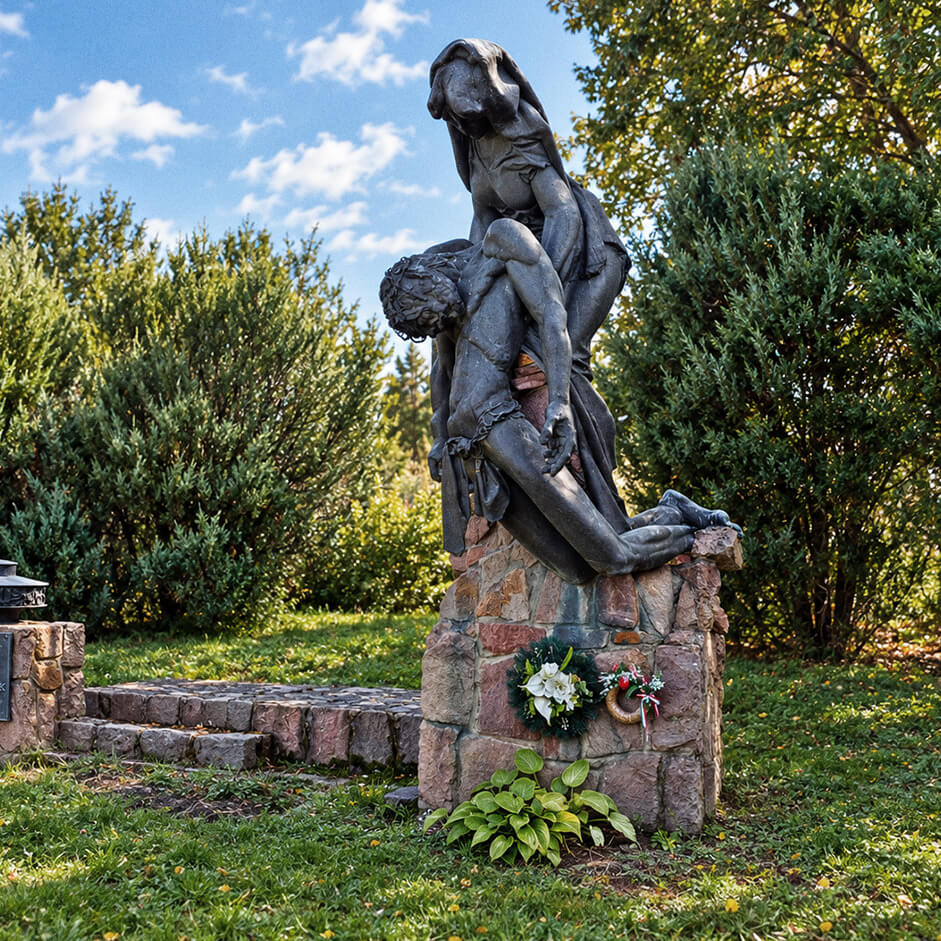
A Pietà stands in the cemetery of Balog nad Ipľom, depicting the Virgin Mary holding Christ after his removal from the cross. The scene draws attention to Christ’s Passion and death and to the sorrow of the Virgin Mary.
According to local historical sources, the sculpture was created by Ján Nagy, a Slovak-Hungarian sculptor. The municipality’s historical summary mentions the Pietà as part of a memorial site in the cemetery dedicated to those who fell in the First and Second World Wars.
The Message of the Pietà
Within the setting of the cemetery, the Pietà draws attention to the suffering Christ and the Sorrowful Virgin Mary. Its presence there therefore links Christian contemplation of Christ’s Passion with the remembrance of the dead.
The sources currently available do not provide sufficient detail about the exact year in which the sculpture was created or the circumstances of its production. What can be established is that local historical records attribute the work to Ján Nagy.
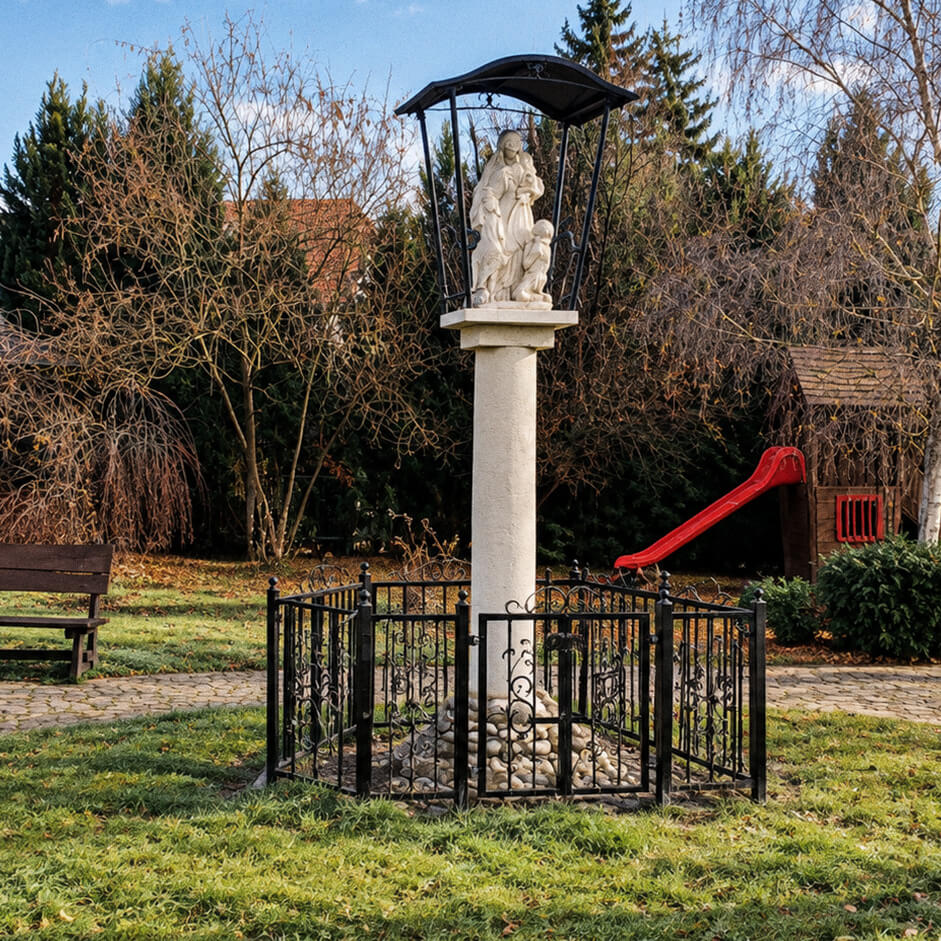
Statue of St. Elizabeth of Hungary
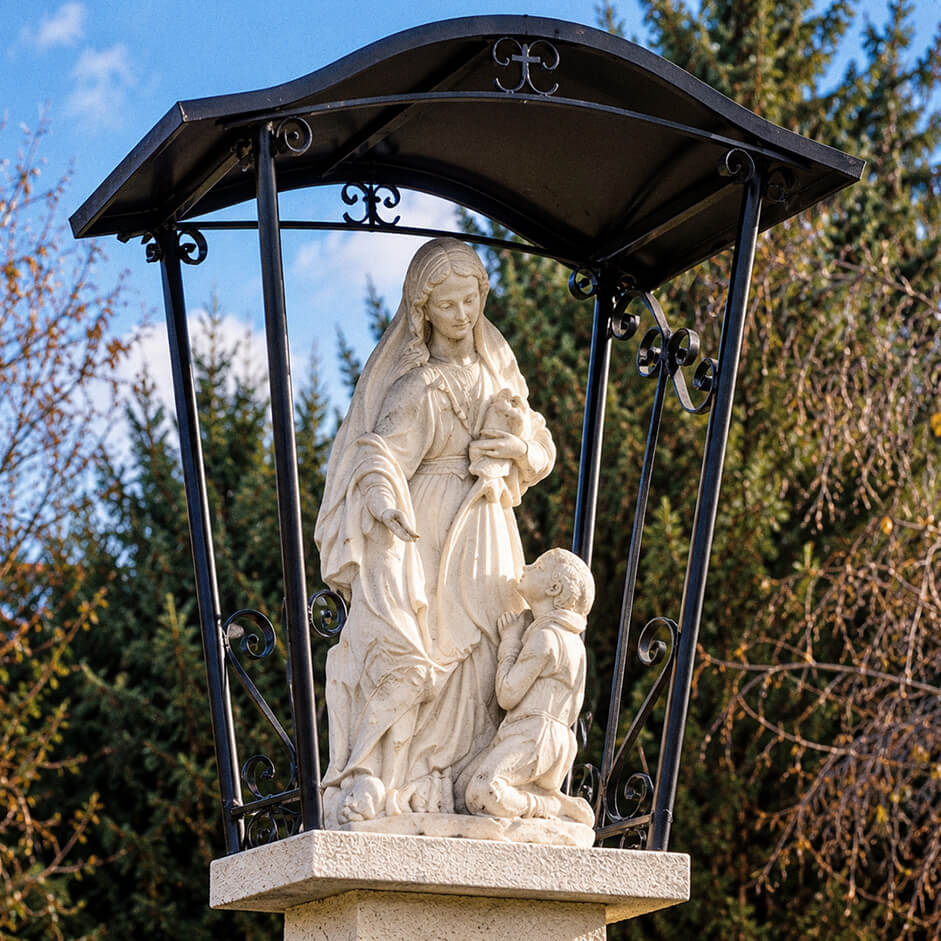
A statue of St. Elizabeth of Hungary stands in the centre of Balog nad Ipľom and is one of the village’s more recent sacred monuments. The Sacred Small Monuments Archive records it as a separate sacred monument.
The St. Elizabeth Memorial Park associated with the statue was established in 2007. On 18 November 2007, during the year commemorating the 800th anniversary of St. Elizabeth’s birth, the park was blessed and the foundation stone for the statue was laid. The statue was formally unveiled on 19 November, the feast of St. Elizabeth.
St. Elizabeth and the Rose
The rose is a traditional iconographic attribute of St. Elizabeth. Its association with her belongs to the traditions and accounts of her life, which is why the rose has become a familiar feature in depictions of the saint.
Among the Village’s Sacred Monuments
The 1872 sculpture group of the Three Saints, the Pietà in the cemetery, and the statue of St. Elizabeth erected in 2007 are sacred monuments from three different periods. Taken together, they show that the religious heritage of Balog nad Ipľom is not confined to a single period of history.
The older sculpture group and the later memorial park were created in different historical circumstances, while the Pietà belongs to the cemetery setting, with its traditions of remembrance and prayer. Though they differ in form, all three monuments are visible expressions of the same local Catholic heritage.