
The Crosses of Balog nad Ipľom
Across the streets and cemeteries of Balog nad Ipľom, as well as along the edges and surrounding countryside of the village, numerous crosses and crucifixes preserve the religious memory of the local Catholic community. Among them are several monuments dating from the 19th and 20th centuries, associated with individual families, cemeteries, sections of road, parts of the village boundary, or personal vows.
These crosses have survived in different forms and with different stories attached to them. They include large cemetery crosses, roadside crucifixes, crosses erected by individual families, and commemorative crosses marking jubilees. Together, they form an important part of the sacred heritage of Balog nad Ipľom.
The History of the Crosses
The earliest known record concerning the crosses of Balog nad Ipľom is preserved in the parish Historia Domus. On 22 July 1849, three crosses were blessed in Balog: one in the cemetery, one in front of the Skerlecz family home, and another on the land of Imre Balogi towards Dolinka. This record shows that crosses were already an established part of the religious life of the village by the middle of the 19th century.
The history of several crosses from later decades has also survived, and a number of them can still be identified today. Their inscriptions, dates and the names of those who commissioned them preserve the religious memory of individual families and of the local community.
19th-Century Crosses
Several crosses were erected in Balog nad Ipľom during the 19th century, and some have survived to the present day, either in their original form or through the memory preserved about them. Among them are the Bolgár Cross, the 1858 cross from the old cemetery, and the cross on the Roth parcel erected in 1867.
The 1810 Bolgár Cross
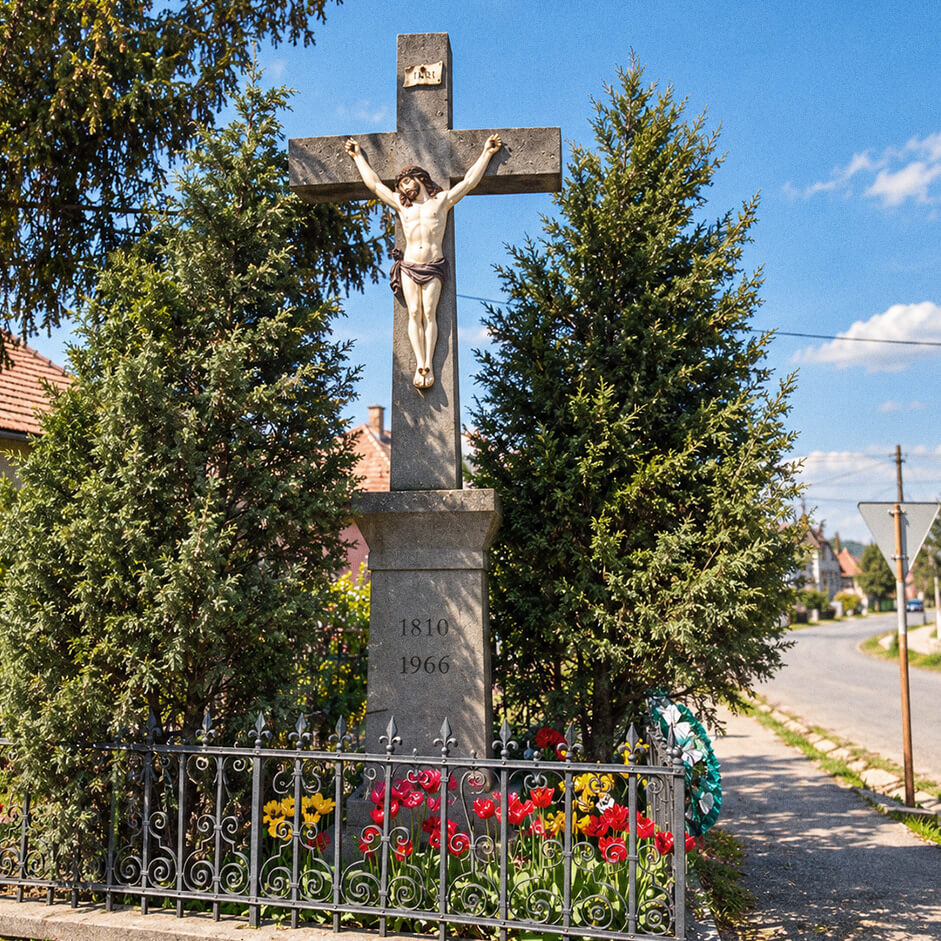
The Bolgár Cross stands opposite the parish house, near the wooden bell tower. According to the sources, it dates from 1810. It is a three-part grey-stone cross with a white iron corpus of Christ and a wrought-iron enclosure. The cross was restored in 1966.
The 1858 Cross from the Old Cemetery
This white artificial-stone cross was erected in 1858 by Török Antal Voszil and his wife, Gyurász Katalin, for the glory of God. After the old cemetery was closed, the cross was moved in 1978, at the initiative of Canon Tibor Montskó and Máté Molnár, to the area in front of the Chapel of the Holy Trinity, where it remains today.
The 1867 Cross on the Roth Parcel
The cross standing on the Roth parcel, opposite the Galamija parcel, was erected in 1867 by Rozália Deák, widow of István Juhász, for the glory of God. It remains as a memorial connected with the village’s earlier burial and religious traditions.
Memorial Crosses of the 20th Century
The 1905 Cemetery High Cross
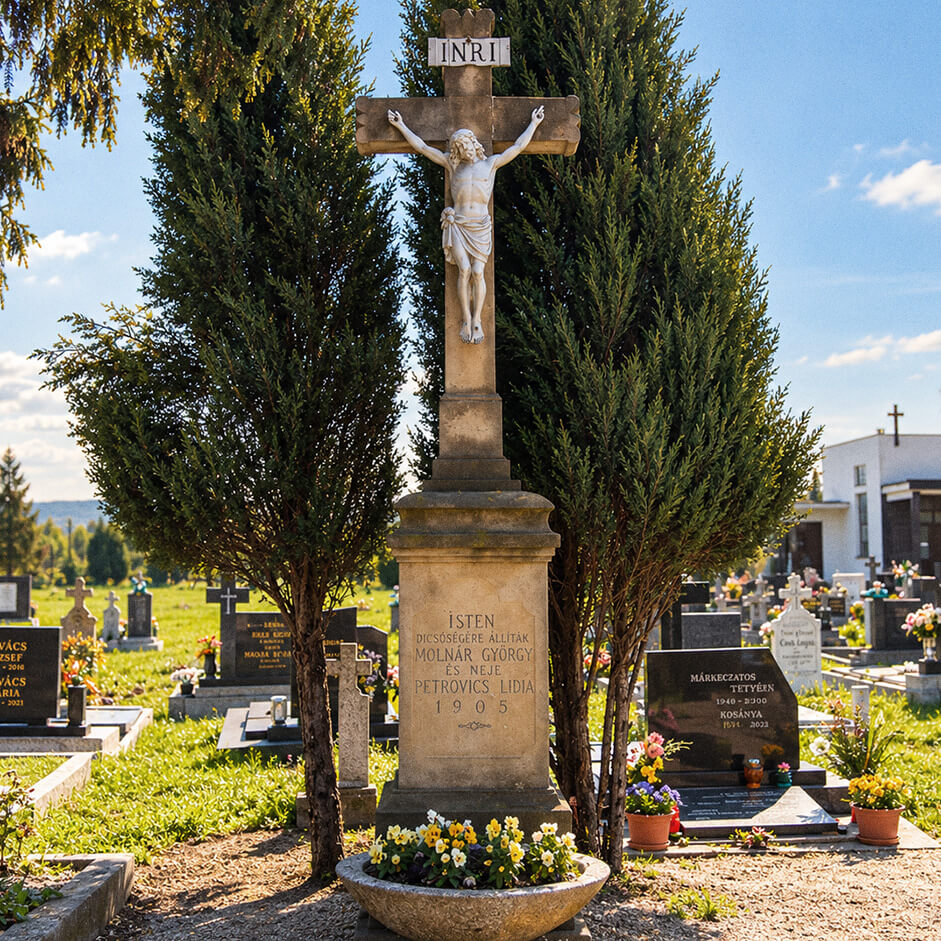
The central cross in the present-day cemetery was erected in 1905 by György Molnár and his wife, Lídia Petrovics, for the glory of God. Its inscription preserves the names of the founders and the year in which it was erected. According to local tradition, its erection was connected with a family tragedy.
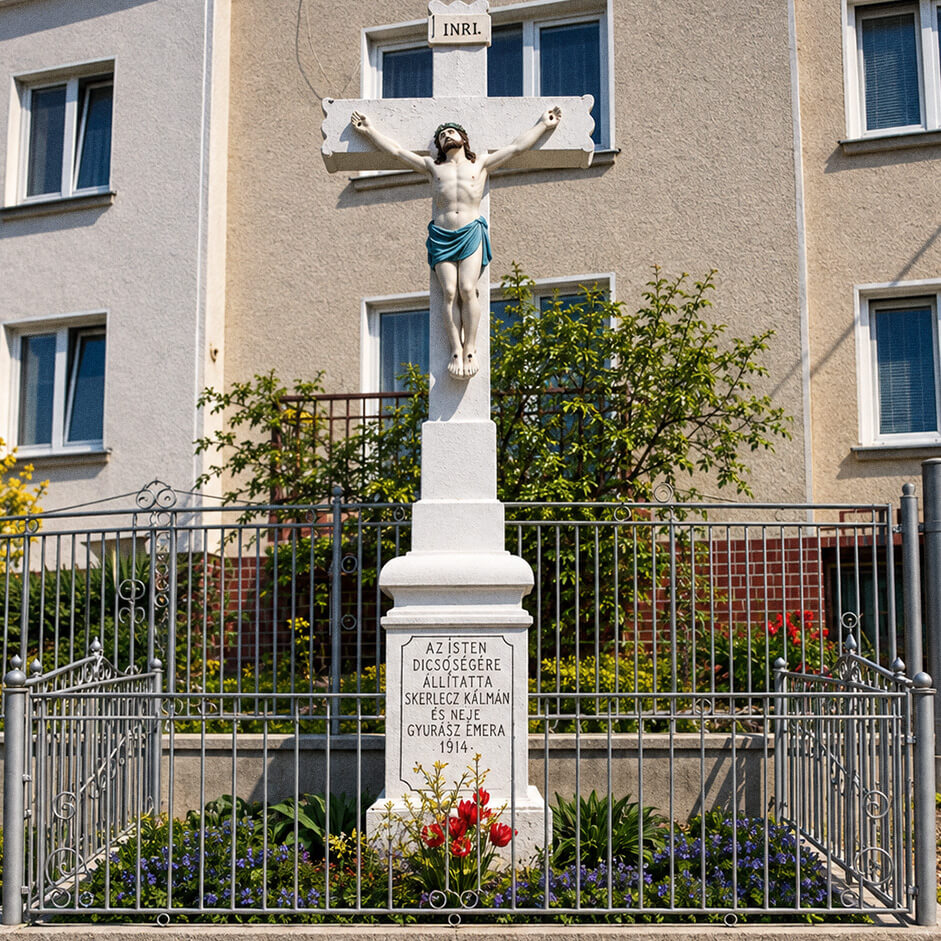
The 1914 Skerlecz Cross
The whitewashed stone crucifix in the centre of the village was erected in 1914 by Kálmán Skerlecz and his wife, Emerencia Gyurász, for the glory of God. It is adorned with a colourfully painted metal corpus of Christ and an INRI plaque.
The 1927 Márton Cross
The Márton Cross stands on the eastern edge of Balog nad Ipľom, beside the road leading towards Dolinka. It is made of white and bluish-grey artificial marble and features a yellow-painted iron corpus and a wrought-iron enclosure. According to its inscription, Lajos Márton and his wife, Mária Rados, had it erected in 1927 for the glory of God.
The Cross on the Galamija Parcel
The grey artificial-stone cross standing on the Galamija parcel, with a metal corpus, was erected in 1938 by Ferenc Paholics and his wife, Veronika Török, for the glory of God.
The Molnár Cross
Máté Molnár had a black marble cross erected in his own garden in gratitude for returning alive from the Second World War and from captivity in Russia. The words of thanksgiving on the cross preserve the memory of this event. The exact year in which the cross was erected is unknown.
The Bodzsár Cross
The history of the grey artificial-marble crucifix with a metal corpus standing in the Bodzsár family garden is connected with an earlier wooden cross that once stood on the site of the former barracks. The pedestal of the present cross bears a prayer addressed to Jesus Christ, together with the dates 1886–1924.
Local historical sources associate the cross with the Ináncs part of the village. The available sources do not identify with complete certainty the person who commissioned its erection.
Memory of Earlier Crosses
Local historical records preserve references to several other crosses as well. These include a 19th-century stone cross opposite the parish house, associated with the Bolgár family, and two so-called White Crosses located outside the village. For these monuments, the sources do not always provide an exact date of erection or identify the person who commissioned them.
The Bolgár Cross
The stone cross standing opposite the parish house is associated with the Bolgár family in local historical sources and is dated to the 19th century. The exact year of its erection and the identity of the original person who commissioned it cannot be established with certainty from the sources currently available.
The White Crosses
Outside the village, in the surrounding countryside, local historical memory preserves two crosses known as the White Crosses. Municipal historical records place them at the end of the street opposite the parish house. Their exact date of erection and the identity of those who commissioned them are not currently known.
The Jubilee Holy Cross
The Jubilee Holy Cross in the church grounds was erected in the Jubilee Year 2000 by Reverend István Nagy, Dean and Parish Priest, a native of Balog nad Ipľom. The cross continues the village’s longstanding tradition of erecting crosses while also commemorating the Jubilee Year 2000.
Crosses in the Village and Its Surroundings
The crosses of Balog nad Ipľom have survived in a variety of locations. They can be found in the centre of the village, near the church and bell tower, in the cemetery, on individual plots, in private gardens, and in the countryside surrounding the village. Their locations reflect different aspects of local life, including everyday life, burial traditions, family remembrance, and religious practice.
Among the crosses outside the built-up area, the Márton Cross still stands beside the road leading towards Dolinka. Other surviving crosses in different parts of the village preserve memories associated with former streets, cemeteries, and the family settings to which they were once connected.
Overview of Documented Crosses
| Cross | Year | Founder / association | Location |
|---|---|---|---|
| Old Cemetery Cross | 1858 | Antal Voszil Török and Katalin Gyurász | today in front of the Chapel of the Holy Trinity |
| Cross on the Roth Parcel | 1867 | Rozália Deák, widow of István Juhász | Roth parcel |
| Central Cross of the New Cemetery | 1905 | György Molnár and Lídia Petrovics | present-day cemetery |
| Skerlecz Cross | 1914 | Kálmán Skerlecz and Emerencia Gyurász | village centre |
| Márton Cross | 1927 | Lajos Márton and Mária Rados | eastern edge of the village, towards Dolinka |
| Cross on the Galamija Parcel | 1938 | Ferenc Paholics and Veronika Török | Galamija parcel |
| Molnár Cross | 20th century | Máté Molnár | private garden |
| Bodzsár Cross | 1886–1924 | not clearly identified in the sources | Bodzsár family garden, Ináncs part of the village |
| Bolgár Cross | 19th century | associated with the Bolgár family | opposite the parish house |
| White Crosses | unknown | unknown | outside the village, in the surrounding countryside |
| Jubilee Holy Cross | 2000 | Dean and Parish Priest István Nagy | church grounds |
The Tradition of Erecting Crosses
In Balog nad Ipľom, crosses were erected for a variety of religious and communal reasons. Some were raised for the glory of God, while others were connected with a vow, an expression of thanksgiving, or an important event in the life of a family. Crosses in cemeteries also served as places of remembrance for the dead and as visible expressions of Christian hope.
Crosses Preserved in Local Memory
The crosses of Balog nad Ipľom are more than religious symbols; they are also part of the village’s historical heritage. Dates, inscriptions, the names of those who commissioned the crosses, and the places where they stand preserve fragments of the history of individual families and the local community. The history of the older crosses therefore offers an insight not only into the religious past of the village, but also into the everyday lives of its inhabitants.
Over the decades, a number of the crosses have been restored, while some have been moved to different locations. The 1858 cross from the old cemetery, for example, was transferred in 1978 to its present position in front of the Chapel of the Holy Trinity. In this way, not only was the monument itself preserved, but another chapter was added to its history.